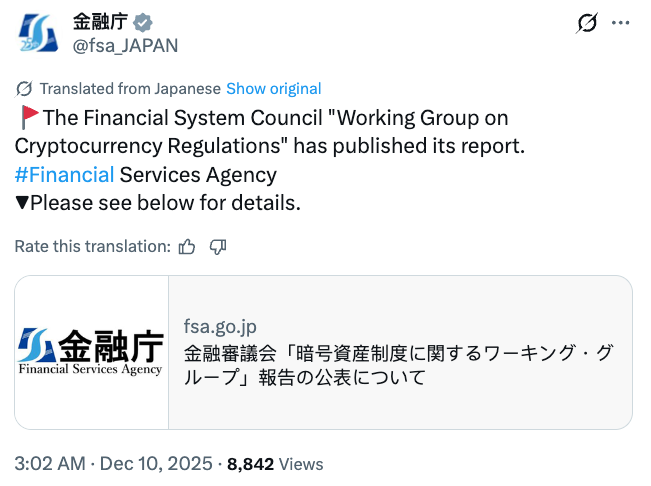
Japan’s financial authorities are moving to bring cryptocurrencies under a stricter regulatory framework. This signals a major shift in how the country will treat digital assets going forward.
The Financial Services Agency outlined plans to transition crypto oversight from the Payment Services Act, which governs payment providers, to the Financial Instruments and Exchange Act, the primary law regulating securities and investment markets.
Treating Crypto as Financial Products
The proposed change comes as crypto increasingly serves as an investment vehicle for both domestic and international investors. The FSA’s report emphasized that proper regulation is needed to protect users by treating crypto transactions more like traditional securities trading. This reflects a growing recognition that many digital assets function as investment instruments rather than simple payment methods.
Stronger Disclosure Requirements for Token Sales
One of the core features of the new framework focuses on initial exchange offerings. Exchanges facilitating token sales will be required to provide detailed pre-sale disclosures, including information on the entities behind the project.
Japan’s Financial Services Agency (FSA) plans to reclassify 105 cryptoassets, including BTC and ETH, as “financial products” and push for a tax overhaul in fiscal year 2026—reducing the current progressive crypto tax rate of up to 55% to a flat 20% capital gains tax. The agency…
— Wu Blockchain (@WuBlockchain) November 16, 2025
Independent code audits will be mandatory, and feedback from self-regulatory organizations will be encouraged. Issuers, even of decentralized projects, must disclose identities and distribution methods for their tokens.
The framework also aims to curb unregistered platforms, including overseas exchanges and decentralized networks, and introduces explicit rules against insider trading, mirroring parts of the European Union’s MiCA regulations and South Korea’s crypto rules.
🇯🇵 Japan is planning new rules where all crypto exchanges will need to hold “liability reserves” to reimburse customers in the event of hacks. $BTC
The move follows renewed attention to unresolved Mt. Gox repayments, showing that strong safeguards can sometimes fail. The FSA… pic.twitter.com/s6WhBI4ykL
— ALLINCRYPTO (@RealAllinCrypto) December 10, 2025
Regulatory Context and Tax Considerations
The move comes as Japan’s government considers adjusting the taxation of crypto profits, proposing a flat 20% rate on all trading gains. Meanwhile, the FSA signaled caution regarding derivatives linked to foreign crypto ETFs, describing the underlying assets as “not desirable” for such instruments.
JAPAN FSA PLANS MANDATORY RESERVE FUNDS IN MAJOR CRYPTO OVERHAUL
– Japan’s Financial Services Agency (FSA) plans to require platforms to hold mandatory reserve funds to protect users from losses caused by hacks, fraud, or system failures.
A Push for Stronger Protection
– The… pic.twitter.com/dqvlmsrzXV
— BSCN (@BSCNews) November 25, 2025
This regulatory shift places Japan alongside other jurisdictions tightening crypto oversight while providing clearer pathways for investor protection. As digital assets continue to grow in prominence, authorities are moving to align local laws with global standards, ensuring that both investors and platforms operate within a robust legal framework.

Disclaimer
The information provided by Altcoin Buzz is not financial advice. It is intended solely for educational, entertainment, and informational purposes. Any opinions or strategies shared are those of the writer/reviewers, and their risk tolerance may differ from yours. We are not liable for any losses you may incur from investments related to the information given. Bitcoin and other cryptocurrencies are high-risk assets; therefore, conduct thorough due diligence. Copyright Altcoin Buzz Pte Ltd.
The post Japan Plans Shift Bringing Crypto Under Stricter Securities Rules appeared first on Altcoin Buzz.