For years, investors trusted the four-year cycle. It felt safe. It felt predictable. The crypto market followed a simple rule: a powerful bull run every four years. But 2026 is challenging that rule. The signals are mixed. The market structure is evolving. Data is shifting. And investors are trying to understand what this shift means for the future.
New forces are pushing the crypto market in directions we have not seen before. In this video, we will break down what is actually happening beneath the surface. The goal is simple: give you a clear map of what may lie ahead. Because when the old rules break, new opportunities often appear first.
Is This the End of the 4-Year Bull Cycle Pattern?
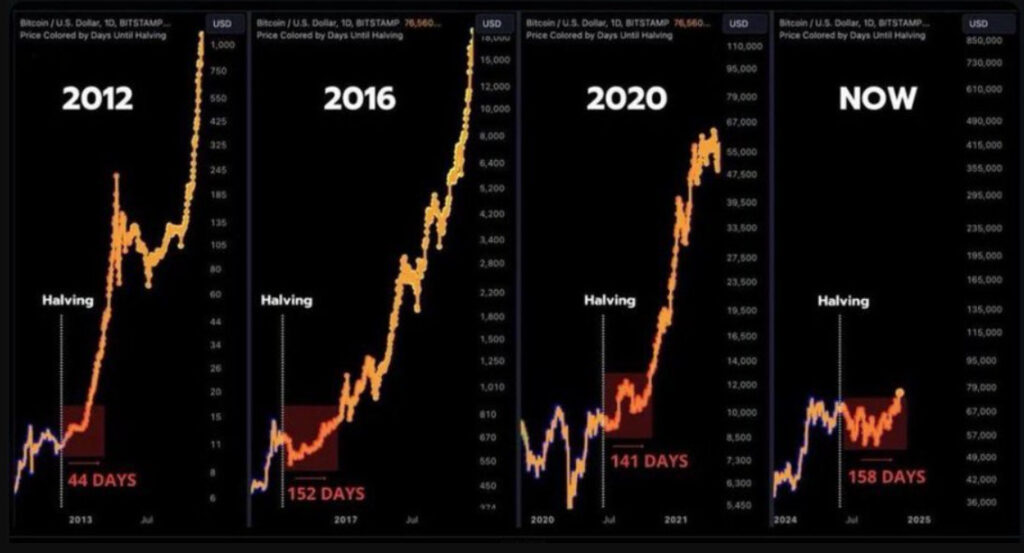
Historically, every halving triggered a massive bull run. We saw a steep correction, followed by a long recovery. Now, this happens roughly every four years.
However, there are signs on the wall that things are changing. For instance, look at the April 2024 halving. Bitcoin already soared past prior all-time highs before the halving. That’s a break from old timing. In January, it pushed past $106k. See the picture below.
Source: X
Later this year, $BTC reached its new ATH of $126k on October 6th. However, a strange thing happened. 18 months after the halving, there’s no “blow-off top,” no manic mania, and volatility remains muted. Now, retail powered earlier cycles. However, they seem to be gone.
no blow off top because:
– market participants more informed about 4 year cycle
– institutions don’t fomo top large green candles
– retail were onboarded in previous cycles— pixel (@spacepixel) September 22, 2025
CT (Crypto Twitter) seems like a ghost town, compared to earlier bull runs. Retail has been taken out by the memecoin casino. Lots of money lost and few winners to show for. It feels like a case of ‘once bitten, twice shy’.
What I do see, though, is the introduction of regulated spot ETFs. You can also add large-scale institutional demand to this. Now, this has replaced much of the retail crowd that powered earlier cycles.
So, instead of wild, emotion-driven swings, demand may now be steadier. This tends to smooth cycles or even remove the extreme boom-bust rhythm.
Is the 4-Year Cycle Dead?
However, not every dip means we are starting a bear-market. Instead, this could simply be consolidation. Or how about rotation under a newly matured market regime? Is that why prominent voices in crypto have recently declared that “the four-year cycle is dead?”
Reminder that the 4 year cycle was driven by halvings and the fact the global credit cycle happened to line up as well.
Halvings don’t matter anymore. Credit cycle has been shifted/stretched out.
4 year cycle is dead.
— Gammichan (@gammichan) November 5, 2025
This includes the co-founder of a major exchange and leading institutional analysts. They argue that new features matter far more than halvings or fixed-interval cycles. For instance,
- Macroeconomic conditions
- Global liquidity
- Institutional flows
MICHAEL SAYLOR JUST ENDED THE FOUR-YEAR CYCLE MYTH 🤯
“The four-year cycle is dead.”
Read that again.
If Bitcoin no longer follows history
and institutions take over price discovery…we’re not in a cycle anymore.
We’re in an acceleration phase.This changes everything. pic.twitter.com/maQv1eJvEb
— Merlijn The Trader (@MerlijnTrader) November 30, 2025
Crypto is maturing. As a result, price action may increasingly reflect long-term adoption, macro conditions, and institutional capital. The days of short-term trading frenzies seem to be over. If so, price cycles may extend or flatten. This yields fewer spectacular booms and crashes. However, we will see more stable growth or plateau and pullback phases.
institutional crypto adoption accelerating in next 1-3 years
driven by: regulation clarity, tokenization of real assets, custodial solutions
this isn’t 2021 retail FOMO. this is BlackRock, Fidelity, and traditional finance moving billions onchain
the game changed 📊
— ☆G (@Gabbyy042) December 3, 2025
Will the Market Move Up, and Which Sectors Lead Next?
I just showed you that Bitcoin’s traditional 4-year rhythm is lengthening. Instead of a predictable halving-to-peak pattern, cycles may now last five years. Liquidity waves slow down and institutional participation deepens.
Even in late 2025, a huge chunk of crypto Twitter still clings to the sacred ‘four-year cycle’ religion. Reality check: that pattern was only valid during Crypto 1.0—the primitive mining/subsidy-driven phase.
Since roughly mid-2024, we’ve already flipped into Crypto 2.0: the… https://t.co/ixnJdpsrtV pic.twitter.com/nHkRV1RwZL
— NewCryptoSpace (@newcryptospace) December 4, 2025
The rise of spot crypto ETFs and large-scale institutional capital blunted retail-driven mania. It replaced wild swings with steadier flows. Thus, making traditional boom-and-bust patterns less likely. This results in less predictable cycles. The days of calendar-based cycles seem to be over.
It’s likely that money will flow in again. However, it will mostly be institutional money. We will most likely see institutional flows instead of retail flows. Crypto ETFs will dominate these institutional flows. In other words, large-cap, highly liquid assets stand to benefit most if or when money rotates back in.
This unlocks massive institutional money
This is the most bullish regulatory move ever
WE ARE SO BACK pic.twitter.com/CtCQIN9l3M
— borovik (@3orovik) December 4, 2025
We saw altcoin ETFs expand in 2025. Some smaller or mid-cap tokens may see renewed demand. Especially those with solid fundamentals or real-world use cases. This is a relief from the memecoin casino. At Altcoin Buzz, we always favored such projects. Chainlink is one of a few alts with successful ETF launches.
🚨 You definitely must have missed this one…
The Grayscale $LINK Spot ETF has already brought in $67.55M in net inflows since it launched on December 2.
Did you expect this kind of demand for Chainlink? What’s your price predictions? 👇 pic.twitter.com/vKJ9OYvrzN
— Wise Advice (@wiseadvicesumit) December 4, 2025
In a more mature crypto market, we will see a change. Projects delivering real utility, network growth, or financial infrastructure may stand out. There’s much less room for speculation driven projects.
Current sectors that should do well include,
- RWA with Ondo Finance ($ONDO) and Chainlink ($LINK) for the infrastructure.
- AI with projects like Bittensor ($TAO) and Virtuals ($VIRTUAL).
- Privacy coins like Zcash ($ZEC) and Monero ($XMR).
- DeFi with projects like Aave ($AAVE) and Uniswap ($UNI).
What Forces Are Reshaping Crypto in 2026?
I said it before, and I will say it one more time. Institutional money is now the backbone of crypto demand. Spot-crypto ETFs now hold well over $150 billion in assets. Big names like BlackRock and Fidelity are involved in this. Recently, Vanguard joined this ETF ball as well, showing huge institutional commitment. This is one of the top American registered investment advisers. They have around $11 trillion in global assets under management.
JUST IN: $11 trillion Vanguard officially lists BlackRock’s Spot Bitcoin ETF, with trading set to go live tomorrow. pic.twitter.com/2nnSjXwu8n
— Watcher.Guru (@WatcherGuru) December 2, 2025
Many institutions now treat crypto as part of their diversified portfolios. It’s no longer just a speculative bet. Only last week, the Bank of America joined as well. It now recommends a 4% Bitcoin and crypto allocation to wealth management clients.
JUST IN: 🇺🇸 Bank of America now recommends a 4% Bitcoin and crypto allocation to wealth management clients pic.twitter.com/9ScKftl9uX
— Charles 👑 (@charleskoh) December 2, 2025
Crypto ETFs also lower friction and onboarding risk in a big way. With crypto ETFs, exposure to crypto no longer requires wallets or keys. Instead, traditional investors can now use standard brokerage accounts. This has reshaped liquidity, price discovery, and long-term demand dynamics. Crypto is becoming more like a TradFi asset than a fringe speculative one.
As global liquidity conditions remain favorable, capital rotates more fluidly into “high beta” assets. Crypto is now increasingly seen alongside equities and macro risk assets. So, there’s no longer a self-contained crypto cycle. Crypto is becoming legit. As adoption grows, speculative frenzy gives way to structural demand.
How to Navigate a Market With No Clear Pattern
So, the question now is how to navigate crypto without reliable cycles? Your first move is to start diversifying. Don’t bet everything on one token or narrative. Spread exposure across different assets, sectors, or even stablecoins. This way you can avoid a collapse if one fails.
2/➫ Position Size & Risk
❍ Kristjan beliefs that you shouldn’t hold more than 20% of your portfolio in one deal.
❍ The same goes for crypto, always diversify your investments and don’t put everything into one coin.
❍ Invest only the amount you’re ready to lose pic.twitter.com/zVAmYqZh8L
— 𝗖𝗛𝗔𝗜𝗡 𝗠𝗜𝗡𝗗 ⛓🧠 (@0xChainMind) April 11, 2024
Instead of “set and forget,” monitor volatility. Rotate out of overheated coins or sectors, adjust allocations when risk spikes. So, use more active risk management and dynamic re-balancing. You also want to favor liquid, high-quality assets or diversified instruments. Pick these over high-risk punts. Adopt a long-term, discipline-based mindset. Make sure to avoid FOMO and hype-driven trades.
Pro tip: If FOMO hits, use limit orders. Don’t chase prices or buy immediately—let them come to you.
Control beats chaos.
What is a limit order?
A directive to buy or sell a cryptocurrency at a specific price or better on your exchange. pic.twitter.com/kgdxCGKZvq— Trend Rider (@TrendRidersTR) December 3, 2025
Will we see a bull run in 2026? That’s hard to predict. Analysts go both ways. Some say yes, some say no. In principle, the fundamentals remained the same. Crypto recently saw a serious drawback. However, many analysts call it an orchestrated trap. However, for a bull run in 2026, macro and liquidity conditions must align.
Technical signals are signaling caution. Bearish technical patterns for Bitcoin, suggest downside or also extended consolidation is possible. Macro, liquidity, and regulatory uncertainty remain real constraints. This could weigh heavily on crypto. In other words, institutional flows might stall or reverse.
#BTC is at a critical level.
Multiple closes below the 50W would confirm the top being in as it always has each cycle.
Regardless of whether the top is in, or if we go slightly higher, I still think 2026 will be a bear market, just like all prior midterm years. pic.twitter.com/4T9fAsQchs
— Benjamin Cowen (@intocryptoverse) November 4, 2025
Still, 2026 could deliver a real bull run. However, global liquidity needs to recover, and institutional inflows need to continue. Finally, if macro and regulatory headwinds don’t derail sentiment. Most likely, it’s a more measured, structural, and selective bull run. Not the frenzied rallies of past cycles.
3 crypto things that make me bullish for 2026.
Part 3: Bull or bear, 2026 will definitely not be a boring year for crypto
While all the major TradFi institutions are entering crypto, the pace will only increase in 2026 across all jurisdictions, making the competition even more… https://t.co/rz4CvLlhsO pic.twitter.com/nXJUj96Nkk
— R2D2 (@R2D2zen) December 4, 2025
How do you see 2026 develop? Let me know in the comments and make sure to follow our X and Discord accounts.

Disclaimer
The information discussed by Altcoin Buzz is not financial advice. This is for educational, entertainment and informational purposes only. Any information or strategies are thoughts and opinions relevant to accepted levels of risk tolerance of the writer/reviewers, and their risk tolerance may be different from yours.
We are not responsible for any losses that you may incur as a result of any investments directly or indirectly related to the information provided. Bitcoin and other cryptocurrencies are high-risk investments, so please do your due diligence.
Copyright Altcoin Buzz Pte Ltd.
The post Is the 4 Year Crypto Cycle DEAD? appeared first on Altcoin Buzz.