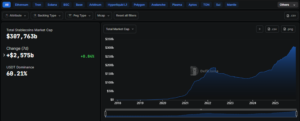
The report arrives at a moment when stablecoin issuance has doubled in just two years, fueled mostly by their growing use in crypto trading.
Yet the paper makes clear that their future will stretch far beyond trading. With the right rules and stronger legal frameworks, stablecoins could support new payment tools, speed up cross-border transfers, and even help expand the global movement toward tokenising assets. At the same time, the IMF warns that these benefits come with real risks that countries must prepare for as stablecoins weave deeper into the financial system.
Market Growth and Expanding Use Cases
Today’s stablecoin market is shaped by fast growth and rising expectations. The IMF points to a clear trend: traders rely heavily on stablecoins to move between assets without touching traditional banks. But a wider shift is taking place as stablecoins begin powering other activities.
One real-world example is how businesses in Latin America use dollar-linked stablecoins to send payments more quickly than through local banks. This reflects a broader interest in tokenisation, a process that turns real-world items into digital tokens. The paper notes that tokenised systems might create more competition in payments by cutting out layers of fees and delays.
If you’re making onchain payments in Latin America, you’re already on Polygon
More stablecoins in the continent are moving on Polygon than on all other EVM chains combined 🌎 pic.twitter.com/ZxybSLFeAY
— Polygon (@0xPolygon) November 3, 2025
Still, stablecoins do not come without challenges. The IMF explains that these tokens can create financial risks, especially in countries dealing with high inflation or weaker institutions. In these places, people might switch too quickly from local currency to stablecoins, which could make it harder for central banks to manage their economies. Volatile capital flows, operational failures, and legal uncertainty add to the list of concerns.
Stablecoins have the potential to reshape cross-border payments and capital flows. They offer opportunities, but also bring new risks—financial integrity, regulatory oversight, consumer protection, capital flow management, monetary sovereignty, and more. Learn more:… pic.twitter.com/cOlZKuqLDF
— IMF (@IMFNews) December 4, 2025
Regulatory Momentum and Global Coordination
As stablecoins expand globally, the rules surrounding them are shifting just as quickly. International bodies such as the Financial Stability Board have issued policy recommendations designed to help countries create strong and consistent oversight. Many regulators are already putting these ideas into practice, though the IMF notes that the landscape remains fragmented.
The IMF didn’t just release a paper on stablecoins.
They effectively published a job description for the next global settlement layer.
They don’t name the vendor. But if you read the specs in their new “Understanding Stablecoins” paper, the plumbing only fits one model.
Here… pic.twitter.com/3xylWPlnu1
— Nigel Houghton (@Nigel_Houghton_) December 4, 2025
Because stablecoins operate across borders, different rules in different countries can lead to conflicts. This is why the IMF stresses the need for global cooperation. It continues to offer policy guidance to its members to help them understand stablecoins’ growing impact and avoid regulatory gaps.
Disclaimer
The information provided by Altcoin Buzz is not financial advice. It is intended solely for educational, entertainment, and informational purposes. Any opinions or strategies shared are those of the writer/reviewers, and their risk tolerance may differ from yours. We are not liable for any losses you may incur from investments related to the information given. Bitcoin and other cryptocurrencies are high-risk assets; therefore, conduct thorough due diligence. Copyright Altcoin Buzz Pte Ltd.
The post IMF Highlights Stablecoin Growth, Risks, and Global Oversight appeared first on Altcoin Buzz.